
Can You Have Direct Primary Care and Health Insurance at the Same Time?










Absolutely. In fact, for many people, Direct Primary Care and health insurance can work very well together.
One of the most common questions we hear when someone first learns about Direct Primary Care (DPC) is:
“If I already have health insurance, why would I also need a DPC membership?”
It’s a fair question.
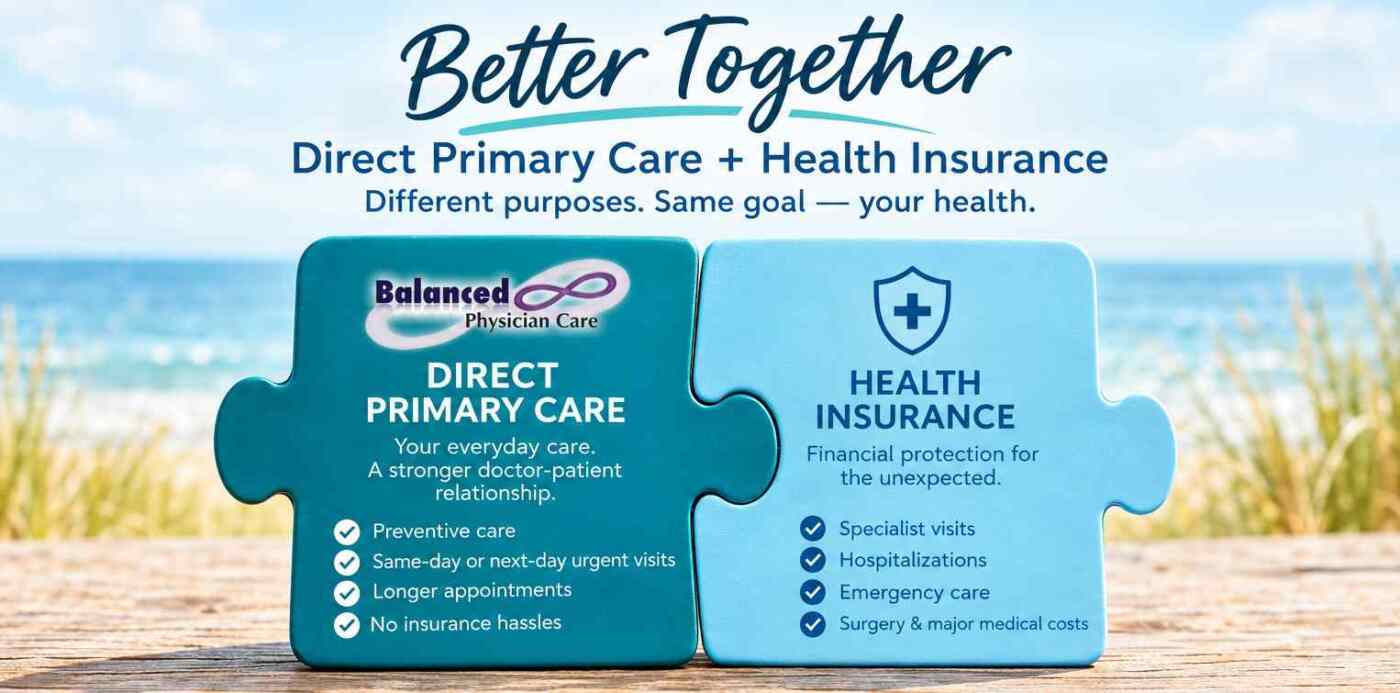
The answer starts with understanding that DPC and health insurance are designed to serve different purposes.
Direct Primary Care focuses on your ongoing primary care relationship—the everyday healthcare needs that often include preventive care, sick visits, chronic condition management, medication discussions, follow-up care, and having a physician who knows your medical history.
Health insurance, on the other hand, is designed to help cover the cost of healthcare services that go beyond routine primary care, such as hospitalizations, emergency care, specialists, surgeries, advanced imaging, and other major medical expenses, depending on your particular plan.
DPC Doesn’t Replace Your Health Insurance
A DPC membership is not health insurance.
Instead, it is a direct relationship between you and your primary care practice. Rather than submitting claims to an insurance company for covered primary care services, you pay the practice a predictable monthly membership fee.
At Balanced Physician Care, that membership gives our patients access to a broad range of primary care services without the traditional fee-for-service approach.
That means you aren’t paying a copay every time you need to see us for an included service, and you’re not dealing with insurance claims for those services.
The goal is simple:
Make primary care more accessible, more personal, and easier to navigate.
So What Is the Insurance For?
Think of your DPC membership as taking care of your primary care relationship, while your health insurance provides financial protection for healthcare needs that may be much more expensive.
Depending on your insurance plan, that may include:
- Specialist visits
- Hospitalization
- Emergency room care
- Surgery
- Advanced diagnostic imaging
- Cancer treatment
- Other major medical expenses
Your specific coverage, deductible, copays, coinsurance, and network requirements will depend on your insurance policy.
That’s why DPC should not be viewed as a replacement for comprehensive health insurance.
Instead, the two can complement one another.
What Happens When You Need a Specialist?
Being part of a DPC practice doesn’t mean your primary care physician has to handle everything.
Sometimes a medical concern can be evaluated and treated within primary care. Other times, seeing a specialist is the appropriate next step.
When that happens, your DPC physician can help determine whether a referral or specialist consultation is appropriate and help coordinate your care.
And when you come back from the specialist, you still have someone who understands your overall health picture and can help you make sense of what comes next.
That continuity is one of the important differences between simply having access to healthcare and having an ongoing relationship with your primary care physician.
But Isn’t DPC Just Another Monthly Healthcare Expense?
This is where many people initially get hung up.
Yes, a DPC membership is an additional monthly expense if you already have insurance.
But it’s worth looking at what you’re actually paying for.
Traditional insurance-based primary care generally involves billing insurance for individual services. DPC operates differently: you pay a predictable membership fee directly to the practice for the primary care services included in your membership.
At Balanced Physician Care, our goal is to eliminate much of the uncertainty and frustration surrounding routine primary care.
Instead of:
“How much is this visit going to cost me?”
the question becomes:
“How can we take care of this?”
That difference can be particularly valuable when you have questions, need to be seen for an acute illness, need follow-up care, or simply want more time with your healthcare provider.
What About HSAs and DPC in 2026?
There is another important consideration in 2026.
Federal law changed the rules surrounding Health Savings Accounts and qualifying Direct Primary Care arrangements. Beginning in 2026, certain individuals participating in qualifying DPC arrangements can remain eligible to contribute to an HSA, and HSA funds may be used tax-free for qualifying DPC fees subject to applicable requirements and limits.
Because HSA eligibility depends on the individual’s circumstances and health plan, it’s important to review your particular situation and the current IRS requirements rather than assuming every DPC arrangement is treated exactly the same.
This is especially important if you have a high-deductible health plan and are considering pairing it with a DPC membership.
Why Would Someone Have Both?
For some people, the combination makes a lot of sense:
DPC for primary care.
Health insurance for major medical expenses.
Your DPC membership can provide a direct relationship with your primary care practice, while your insurance remains available for healthcare expenses outside the scope of the DPC membership.
This can give you two things that are often difficult to get from a traditional healthcare arrangement:
Predictable primary care costs and protection from large medical expenses.
The Question Isn’t Really “DPC or Insurance?”
A better question might be:
“What do I want from my primary care physician?”
Do you want to be able to reach your primary care practice when you have a question?
Do you want longer appointments instead of feeling rushed through your visit?
Do you want same-day or next-day care when you’re sick, when available?
Do you want a physician who has the time to understand your medical history and your health goals?
Do you want to spend less time dealing with insurance-related hassles for your routine primary care?
These are some of the reasons people choose Direct Primary Care.
DPC and Insurance Can Work Together
Direct Primary Care isn’t about eliminating health insurance.
It’s about changing the way you access primary care.
You can maintain your health insurance for the medical expenses that fall outside your DPC membership while having a direct relationship with your primary care practice for your everyday healthcare needs.
At Balanced Physician Care, we believe primary care should be personal, accessible, and centered around the relationship between the patient and the physician—not the insurance company.
If you’re curious about whether Direct Primary Care makes sense for you, we’re happy to explain how the membership works and answer your questions before you make a decision.
Give us a call at Balanced Physician Care to schedule your no obligation, Meet & Greet – 904-930-4774.
