Alex Minsistrator

About Alex Minsistrator

Posts by Alex Minsistrator:

Doctor Google

Paging Doctor Google

You may think Doctor Google is great.  You maybe in a pinch. No one is available to answer your medical question.  You just can’t wait until Monday at 9am to call the office. If you could wait, you know you’ll be put on hold and won’t get a call back for hours - if you’re lucky.  You know if you do get a call back, it will likely not be from YOUR doctor. So, why not just Google it?
You may think Dr Google is great when you’re in a pinch and need a quick answer.  But, despite what many people think, Dr Google isn't as good as a real doctor.  You’re twice as likely to get the real diagnosis when you talk to your doctor versus when you Google.  That means, many times Google searches will bring up all kinda crazy answers that are definitely wrong. These things might be scary (creating more anxiety instead of calming your fears), inaccurate (causing you to start a treatment that is incorrect and may have side effects that you don’t need), or miss the real cause (leading you to falsely believe you are fine, when you have something more serious happening). 

All that being said, we get why patients don’t see the doctor.  In this world of quick technology and easy answers, it’s tempting to go the Google route.  But, what if you COULD have a doctor who is available to answer your question. What if she WAS available before Monday at 9am?  What if he COULD call you back instead of one of his colleagues? What if it DIDN’T TAKE HOURS to hear back? Would you still Google?

While the answer for some of you may still be a vote for Dr. Google, we’re certain many others would prefer the expertise of a Board Certified Physician!  To each, his/her own - BUT if you’d rather have the opinion of YOUR doctor right at the tip of your fingers, give Balanced Physician Care a try and find out why patients love the 24/7/365 access and connection to their Primary Care Doctor!

Balanced Physician Care is a Direct Primary Care practice located in Ponte Vedra Beach, Florida and serving all of Jacksonville's First Coast. Our physician-owner is Sharyl Truty MD. Visit BalancedPhysicianCare.com/membership for more information on how to become a member.

National DPC Commercial

If Direct Primary Care Had a National Commercial

Direct Primary Care really is that easy. It's a "Progressive" way to get your primary care. 

We’ll see how long until Progressive gets mad at us for using this. Until then, feel free to share. Send it to family. Whatever. We hope you get a chuckle out of it as well.

Courtesy of DPCNews.com.


PPO vs HMO

Is a HMO or PPO better with a Direct Primary Care practice

The two most common types of health insurances that we see today (outside of medicare and medicaid) are called PPOs and HMOs.

Picture

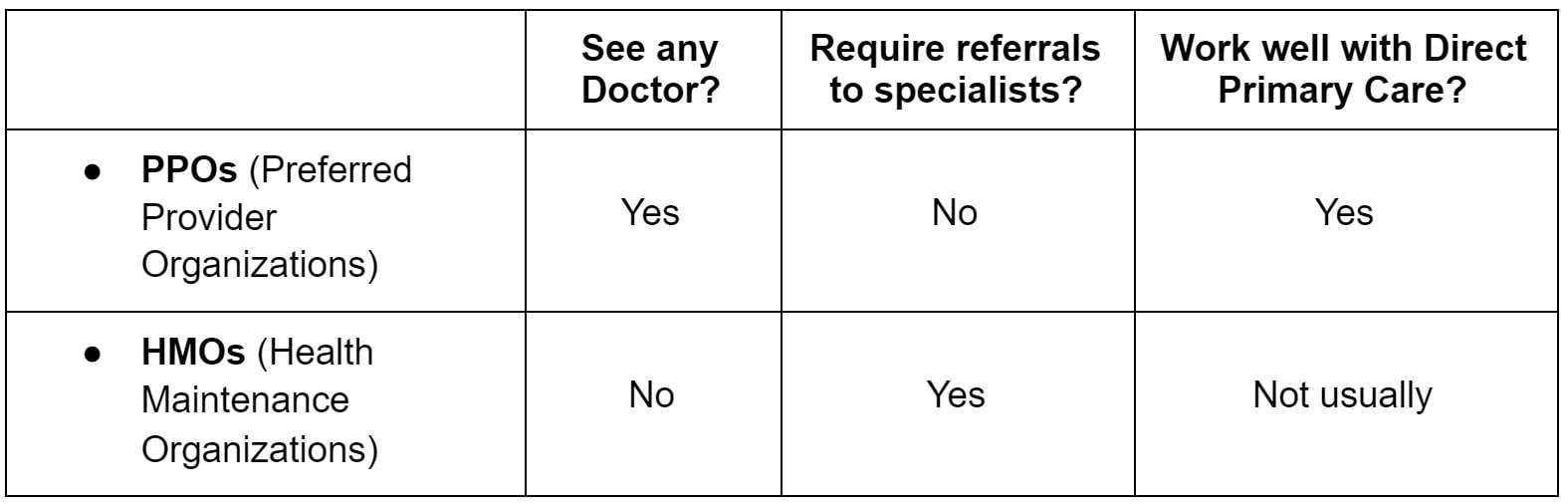
The short and sweet of it is that HMOs are very restrictive and want you to remain in their “network” - which means you need a Primary Care Physician who participates in the network with them.  Such a physician has signed paperwork saying they will follow the insurance companies rules, only refer you where the insurance company says, and receive payment when they bill your insurance of a set rate.

On the other hand, PPOs are flexible.  They allow you to go “out-of-network” - including not only any specialist you’d like to see but also any primary care doc!  That’s why we encourage patients to check their insurance plan before joining our practice.  If your plan is an HMO, it lets us (as out-of-network doctors) to care for you as you and we see fit.  The gist is that we can see you, you can see who you want, and we are only paid by your monthly membership fee to be part of the practice.

If you’re a patient who has lots of specialists and needs help with coordination, likes the idea of a doctor who is not “on the hook” with the insurance companies, or just plain likes the idea that you can choose who you’d like to see - a PPO plan alongside a DPC doctor - like us at Balanced Physician Care! - might be the perfect match for you.  And no it's not paying twice for healthcare, we think it’s making a smart choice for your health!  For more on how we practice primary care differently in Jacksonville, FL, check us out at BalancedPhysicianCare.com

Tricare plus BPC

Tricare and Balanced Physician Care

TRICARE is an incredible benefit for members of the armed services and retirees, and a couple of its versions work exceptionally well with a Balanced Physician Care membership. The ability to get lab and imaging tests as well as some specialty care directly from the base means you can get the best of both worlds.

TRICARE SELECT

TRICARE Select (formerly TRICARE Standard) is a version that has small enrollment fee (like a premium) of $12.50 per month ($250 annually) individual and $25 per month ($300 annually) for a family

 enrollment fee is waived if you’re:

  • An active duty family member
  • A medically retired retiree or family member
  • A survivor of an active duty sponsor or medically retired retiree

A 20% cost-sharing (also known as co-insurance) for charges incurred outside of the “direct” system.  Direct means you’re getting care, tests, or prescriptions directly from the military clinic. Pairing your Select plan with a direct primary care membership means you get fantastic, easy-to-access primary care for an affordable cost. No worries about getting in to be seen the day you call, and you’ll see your doctor when you do. Labs, imaging tests, and prescriptions can still be done at the base at no cost.  If you need care that neither the membership nor the military clinic can provide, we work to make sure you know what something is going to cost before you go. 

TRICARE FOR LIFE

TRICARE for Life is essentially second-payer coverage for Medicare for people 65+ or otherwise eligible for Medicare. It also works great with a Balanced Physician Care membership for the same reasons is works for TRICARE Select — affordable access to your doctor when you need it AND the ability to get tests and prescriptions from the base. We appreciate your service.  

TRICARE PRIME

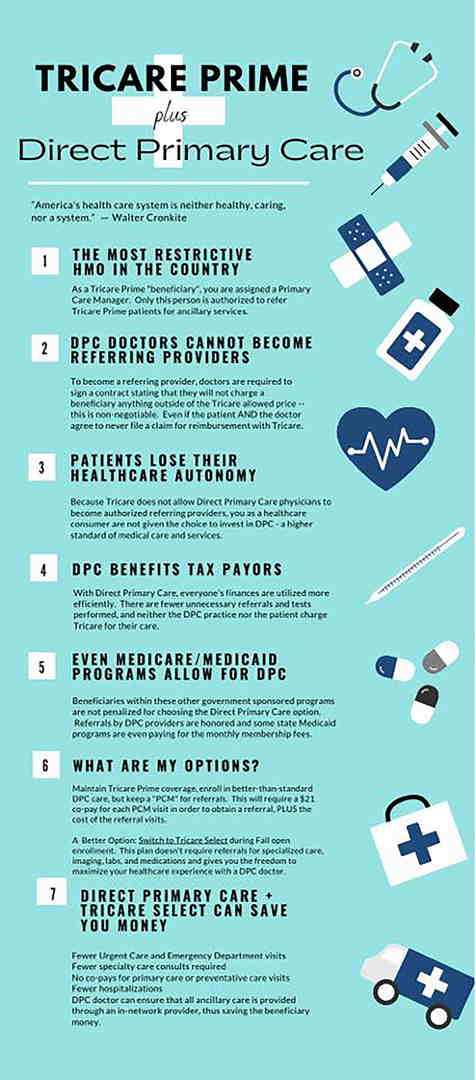
Unfortunately, Prime doesn’t work quite so well with a Balanced Physician Care membership.  Prime functions like a “health maintenance organization” (whatever that is), which limits Balanced Physician Care’s ability to do referrals. It’s still an option, but you’d basically just have to operate outside the system.  

The bottom line is that TRICARE Select and TRICARE for Life work great with a Balanced Physician Care membership — the relationship, access, and value we provide in our clinic combined with the ability to still get tests, medications, and specialty care at the base at no additional cost!  

To learn more about the membership options at Balanced Physician Care.  Visit our membership page


Tricare Prime- Direct Primary Care
direct primary care circles

Direct Primary Care: Are the results worth the time, effort and money for employers?

Direct Primary Care makes complete sense as a concept. In the real world, of course, it’s a bit more messy and complicated, especially within the confines of an employer’s health plan, and finding the right pathway to achieve the desired results is sometimes tricky. Replacing the traditional entry point to a health care journey with a higher-performing primary care partner sounds ideal, up until the point when personal preferences and emotional bonds prove larger barriers than originally expected.

The main arguments against the traditional primary care pathway include:

  • Providers get paid on a fee-for-service basis, so they are rewarded for managing chronic conditions and have no financial incentive for simply curing a condition.
  • Primary care providers have to see too many patients in a day to meet the needs of a huge patient “panel.” Appointments are rushed, and rather than root-cause health care, only symptom-management is typically discussed.
  • Primary care doctors often refer to specialists to protect from liability or malpractice claims.
  • Upstream medical practices (i.e., more expensive providers such as hospitals) have purchased primary care providers to control the pathway to their services, and thus silently influence volume and referral patterns away from primary care treatment to their affiliated and more expensive providers and facilities.

The main value-propositions heralded by the DPC provider often include:

  • Smaller patient “panels” equals more time spent with the patient (member).
  • Money is spent to achieve wellness.
  • Direct primary care is free from financial pressures and upstream interests.
  • The DPC model focuses on a broader scope of services and refers to specialists less often.

So, yes, it’s easy to see how the employer or consumer starts to recognize the advantages of this strategy. If the employer shifts their money from paying for services and instead moves that investment into a direct primary care relationship, their employees should get better care through a relationship with a provider who is compensated to focus more time on their employees and have fewer upstream referrals for testing and specialist interventions.

Built-in or bolt-on options for employers

There are several factors that determine whether the membership fees that a direct primary care practice receives are paid on an invoice basis to the employer, or whether their health plan administrator or TPA will make that payment.

Fully insured scenarios

The first and easiest distinction is the fully insured health insurance plan and its relationship to DPC practices. This one is simple: There isn’t a relationship. The DPC practice has rejected the traditional fully insured plan and built a practice where that relationship is predominately viewed as toxic and unhealthy for the patient and the provider. If an employer wants to establish a DPC relationship for their employees and the employees’ family members, this is a “bolt-on” option. The employer will either pay a monthly invoice for the membership fees, or the employees will pay directly and get a reimbursement from their employer.

Now, if you’re wondering, “Why would an employer pay extra for a DPC membership on top of their high-cost health care?” you are not alone.

I asked Dr. James Pinckney of Diamond Physicians in Dallas about this during my very early investigation into DPC in my local community. His response was simple: It’s about access and providing a huge benefit. His clients who were doing this were looking to provide an unparalleled benefit, and this was a simple way to do so while showing interest in the wellness aspect of their employees’ lives through the DPC memberships.

Most brokers I’ve spoken with who have this arrangement often use a high-deductible plan as the insurance vehicle for these arrangements, either because they need to save some money on the insurance to finance the DPC investment, or because the client already had an HDHP and needed to find a solution to address the perceived barrier to care that the health plan’s deductible was creating in the minds of their employees.

Self-insured or level-funded scenarios

The self-insured health plan is a much easier vehicle to customize with a built-in DPC option. When working with a plan’s administrator, you can typically arrange a per member per month fee to be invoiced to the employer and then submitted to the DPC practice, or you can define how the membership will be paid from the plan’s claims funds each month.

Of course, the real world is more complex than that made it sound.

Not all self-funded or level-funded plan administrators are adaptable. Some will simply have a set number of plan designs and pre-set protocols that they can’t and shouldn’t deviate from due to their operations. Others will give great lip-service to the concept and promise to accommodate, then utterly fail when it comes to execution or implementation.

To be fair, this is still a new process and hasn’t yet been adopted by the masses. Thus, most are learning with us as we go. And a plan administrator that can’t coordinate the monthly membership fees shouldn’t be a deal-breaker. Most DPC practices actually prefer to receive their payments directly from the employer group. Running a DPC arrangement as a bolt-on solution is not a horrible outcome, even with a self-funded plan.

I talked to Josh Butler of Butler Benefits about his experience with the bolt-on approach as the purest relationship for the employer and the DPC practice. “I’ve seen two mindsets from our employers. They either want to work directly with the DPC providers and form a deeper partnership with them, or they want to see the health plan take care of the tactical aspects of the provider relationship.” When I asked him which he saw driving better results, he said, “What kind of question is that? You know the employer that gets their hands dirty finds the gold.”

But, there is still great upside potential in the self- and level-funded arenas for the DPC arrangement to take hold and multiply.

For one thing, upfront cost reductions are possible here. Some stop-loss vendors will give discounts for a plan that uses a DPC solution. I’ve seen quotes that reduced insurance costs in the $25 to $40 per member per month range, and I’ve heard from peers about even higher per employee savings.

Coupling this fixed cost savings with the plan’s year-round performance through reduced upstream costs each time a member avoids unnecessary or overpriced care should be sweet music to the employer’s ears.

Prescription costs are another area of concern for the self-funded health plan, and monitoring the prescription usage before and after implementing a DPC strategy can help shed light on the greater potential of this relationship. Prescription usage will obviously be a slower impact item, but having that higher engagement and the anecdotal data that most DPCs gather after blunt conversations about the cost of care and the cost of prescriptions will inevitably begin to assist the plan’s performance in this area.

Preparing for the complex scenarios

Inevitably, the actual implementation will be some variation or expansion on the simple DPC arrangement. There will be an adjustment to the concept based on discussions that arise with the employer and their leadership team. There will also likely be adjustments once all parties review prices from various DPC vendors and after employees provide their feedback.

More than one DPC vendor

You will need to be prepared to address the impact of geographical regions, which could include discussing a 20-minute drive across one city, a two-hour commute between different counties in the same state, or even coverage across multiple states.

Some DPC practices have grown their own geographical footprints to meet the needs of the customers they currently serve through hiring; some of those practices will also extend their billing and administrative services to other independent DPC practices to create a seamless experience for the employer group, while not having to own and staff a new region.

And there are software services that can leverage existing relationships to create custom networks of DPC practices. These services have really started refining their deployment, and while these services typically add expense to the setup and administration, the flexibility for a multi-location employer to deploy a DPC solution without spending the time to create individual relationships or band-aid geographic holes can be a huge value for the right clients.

Sharing DPC costs with the employee

This is where we come back to the built-in or bolt-on conversation. This is really a moot point in the built-in scenario when the plan or TPA administers the membership fees, and the employer has bundled everything into the traditional payroll deduction scenario. But, in the “bolt-on” or separate enrollment and billing scenario, things get more interesting.

Tom DiLiegro of Benefits Advisors of South Charleston has seen the full spectrum. “When the employer understands the impact and the savings at stake, they immediately want to pay for the membership fees in full. Once they start to consider employees who don’t go for routine care today, they start down the slippery slope of not wanting to pay for medical care on behalf of employees who don’t receive care today. Inevitably, they end up with a 75%/25% cost-sharing or 100% cost-sharing for a limited time, but then reduce or remove the employer portion of the DPC for those employees who don’t have their first visit within a set number of months into the new DPC arrangement.”

DPC and VDPC options and combinations

All DPCs have virtual care covered in their memberships; that is one of their main value propositions. Some even give price breaks for a virtual-only membership. But the emergence of 100% virtual primary care practices and the expansion of services offered by telemedicine solutions is going to be central to any DPC conversation.

My personal experience has been predominantly with the DPC/VDPC combination using two different vendors. The structure is to use a DPC for those in a reasonable geographical location, and a virtual-only vendor for employees who live in a region without a feasible DPC relationship, or a region without enough employees to establish a company-paid membership with a DPC provider. This isn’t always the solution that the DPC partner prefers, but the price point on these arrangements is often more palatable for the employer groups and the VDPC vendors are often easier for the employer to deploy.

Sherpaa founder and CEO Jay Parkinson’s prediction that care will be “primarily online and strategically in person” is increasingly likely and occurring a little quicker than even he expected when he offered this as a central theme to a talk he delivered in February 2020.

Worth it?

So many hurdles, shifting scenarios, and uncertainties beg the question: Are the results worth the time, effort and money?

This is about a journey in pursuit of a different result. When an employer, advisor or individual wants a reset on their health care expenditure, they need to try a new path. Whether the first step is a DPC arrangement, a virtual DPC, or even contracting directly with a traditional practice willing to perform in a more attentive and high-value manner similar to the ACO model, a new pathway that starts with primary care is a sensible place to start.

Savings might occur immediately, in year three, or might never be realized, but anything strategically done to lower costs and improve the health of a workforce has to be considered worthwhile.

Want to learn more about Direct Primary Care for your business?  Visit our dedicated employer page - www.HealthcareforJax.com


  • Article from Benefits Pro 4/7/21 -Bret Brummitt is a benefits consultant and the founder of Generous Benefits.​
Health Cost Sharing Header 2021

Health Cost Sharing 2021

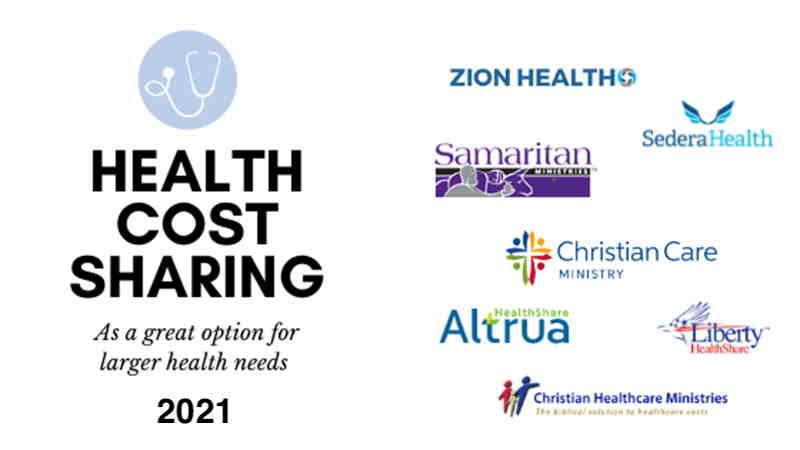
The very concept for and purpose of insurance is to protect one against unpredictable and large expenses, such as damage to your vehicle from an accident, or to your home from a hurricane. In health care where there is virtually no transparency, most health care costs are purposedly unknown, falsely creating a need for insurance for even routine care. Charges are frequently inflated, and “discounts” off these inflated charges by health care facilities are advertised by insurance companies as evidence that they are working on your behalf to get your value and savings for your insurance plan.

The Direct Primary Care (Balanced Physician Care) membership model absolves the need for insurance for non-emergency care, from physician consultations to ancillary services, such as laboratory and radiology services. All costs are transparentaffordable and predictable with the all-inclusive monthly membership. Various private surgical groups are now publishing all-inclusive non-emergency surgical procedures so insurance is even not needed for them.

The Direct Primary Care model allows members to purchase insurance or other plans purely for catastrophic needs at a much lower cost by forgoing inclusion of routine care in their plans. Unless you have chronic medical conditions that truly require the care of a specialist physician and expensive medications (about 15% of you), a health cost sharing plan may be just what you need. These programs compliment a DPC membership perfectly, at a combined cost that is usually half of traditional insurance offerings

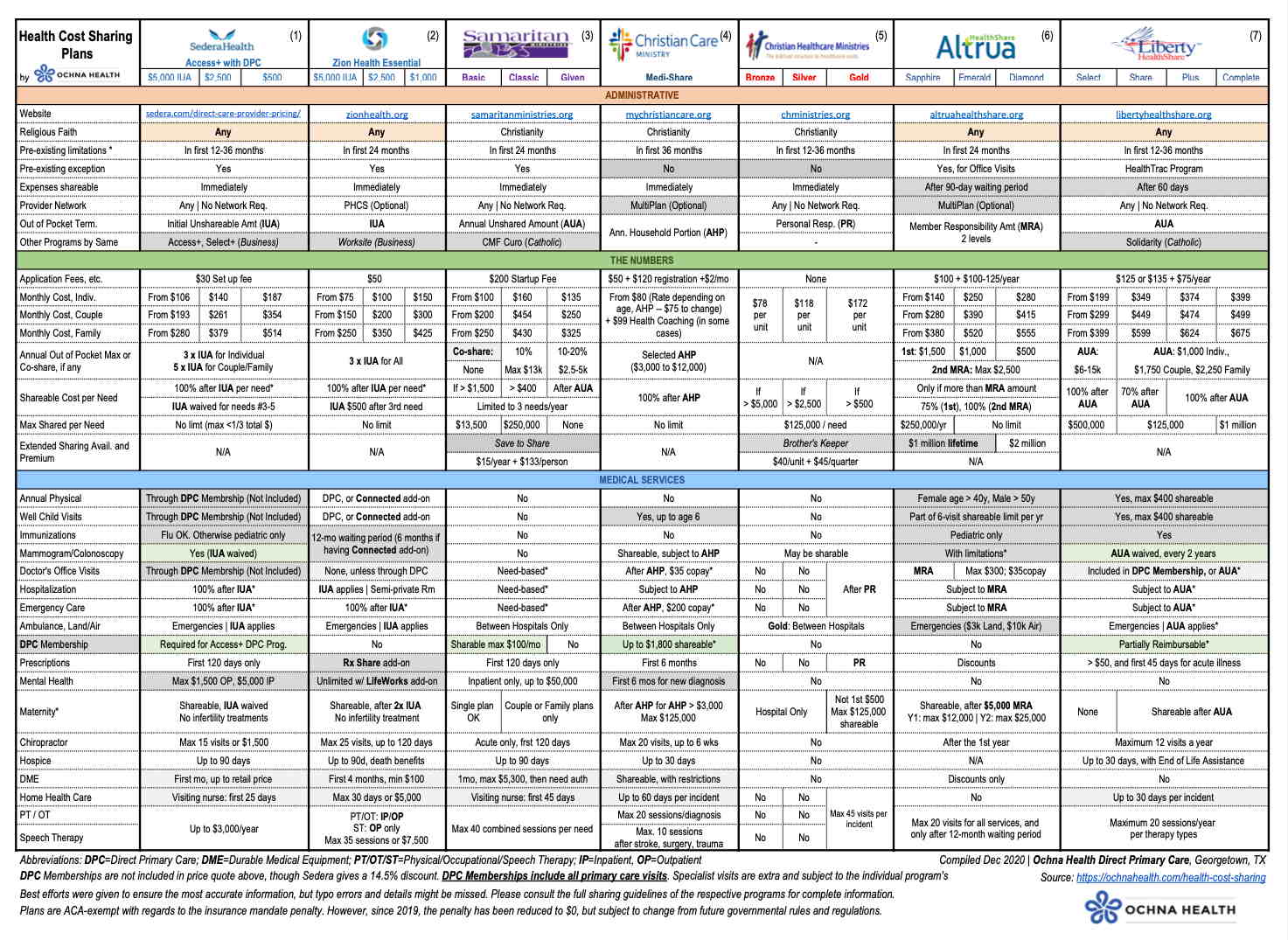
Thanks to Ochna Health for the chart below. They have revised it annually to reflect the changing marketplace. It is our hope that this updated version will guide you to a solution to your health care needs.


Health Cost Sharing 2021 Comparison Chart
choosing a healthshare

Choosing a Christian Healthshare

Listen to the Pulling Curls Podcast above on choosing a Christian Healthshare.

What is covered.

  • What a healthshare is and how it basically works.
  • How they maneuver around the health insurance mandate
  • Their experience with CHM, Liberty and Zion Healthshare

Zion Healthshare

Liberty Healthshare

Christian Health Ministries


Local Covid-19 Vaccination Info

Local Phase 1 Covid-19 Vaccination Information

APPOINTMENTS ARE REQUIRED IN ORDER TO RECEIVE THE VACCINE.

Appointments are exclusively available for Phase1A prioritized groups which are as follows:

  • Residents age 65 and older
  • Health care workers

One person per appointment is permitted; individuals without appointment will be turned away.

What to bring to your appointment

  • Must present valid ID that show you are 65 and older
  • Health Care Worker, bring your employee badge

Make an Appointment Online

  • Check below for each County appointment links
  • Walk-in appointments WILL NOT be accepted.
  • Please note that the Moderna vaccine requires 2 doses that are 28 days apart.

Duval County
 

The Duval County Health Department announced new appointments will be added through the online system every Thursday at 5 p.m.

Appointments can no longer be made by phone. Only online appointments are available.

”The link will change each week and will be posted on the Department of Health -Duval website: duval.floridahealth.gov. Click on the yellow alert box.
 

St Johns County

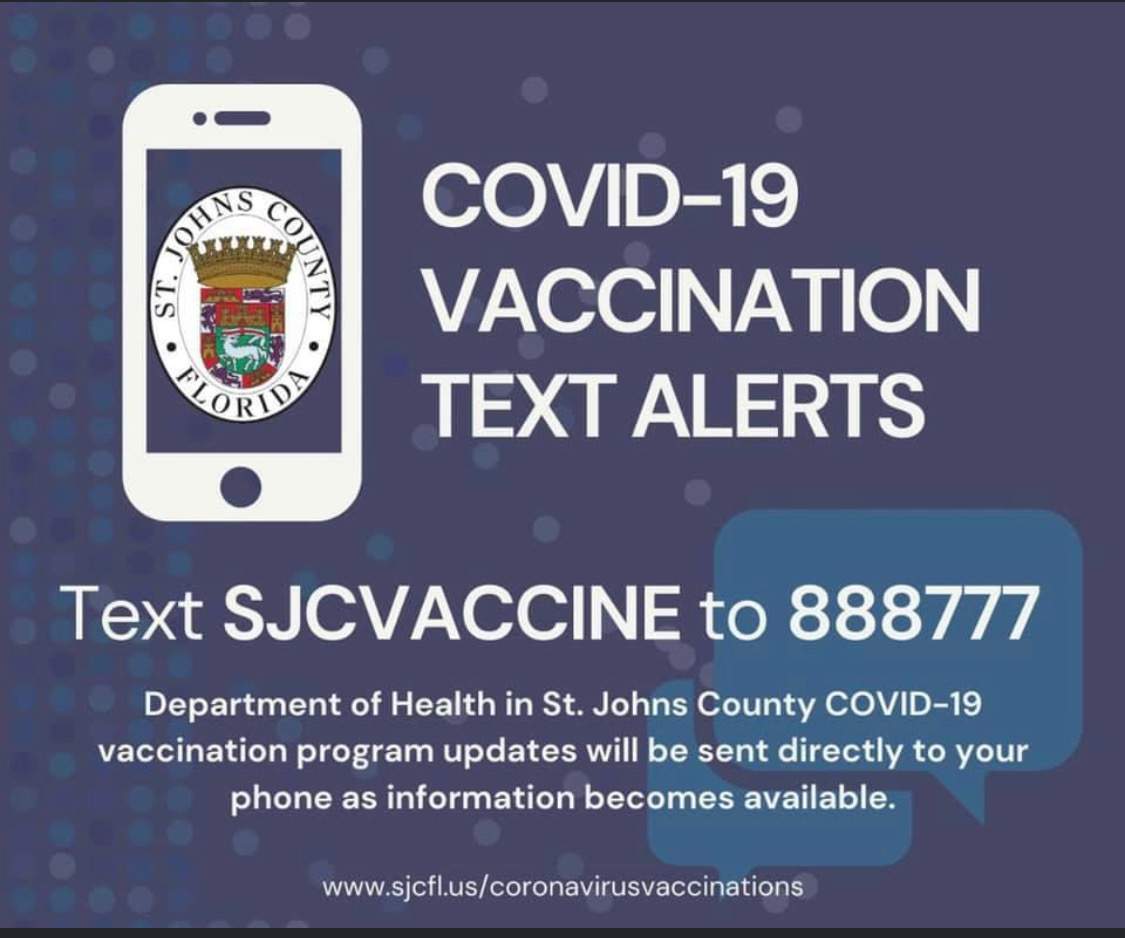
Online registration to make a vaccination appointment will open at 9 a.m. on Thursday, January 7, for appointments on Friday, January 8,” a notification from the county’s Emergency Operations Center said. “A registration link will be announced Wednesday, January 6 at www.sjcfl.us/coronvirusvaccinations

St Johns County Covid Vaccination Text Alerts

Clay County

According to Clay County, all appointments to receive its initial allotment of 3,000 doses of the Moderna COVID-19 vaccine have been filled and there are no additional appointments at this time. Clay County said that as soon as the state provides an update on additional allotments, the county will open for additional appointments.

The county website to sign up is alert.claycountygov.com

For the latest updates please visit the following Balanced Physician Care social media pages

Facebook Link

Twitter Link

mad patient

Why Does My Primary Care Office Refer Me to an Urgent Care?


Your average physician’s office cannot accommodate the needs of the 2000+ patients that they have per doctor in the normal day.  If the doctor is full or not in the office that day, they will often either recommend that you come in and see a non-physician practitioner or go to the local urgent care where you can walk-in anytime you need it.

At Direct Primary Care practices, like Balanced Physician Care, we do our best to be available to our members when you need it.  24/7, 365 days a year we can be sure to get back to you when you have an urgent need.  Our members email or call our after-hours phone number when they have an urgent concern and they hear back from their doctor directly within hours (and usually within minutes!).  When scheduling allows and the need requires an in-person assessment or treatment, their doctor directly schedules them to come in for what they need. 

​Amid COVID, this has been super helpful for our members.  When a member has a cold and doesn’t know what to do, we can discuss remotely what the best course of action is, refer them to rapid testing, or schedule a COVID test fairly quickly to help guide next steps.  

We keep our panel of patients to under 600 patients with 2 providers, unlike the national average in a regular Fee-For-Service practice of 1000s per provider.  This lets us be sure we can offer what we’re recommending to patients without long wait times on hold with a receptionist.  We call, email, or message our members back directly and we arrange their urgent visit when needed.  We can also handle many urgent requests remotely (i.e. that annoying UTI is back and you need the antibiotic again - you don’t have to have a visit!).  

To find out more about how direct our care works and how Balanced Physician Care practices it, give us a call at 904-930-4774


end of pandemic

How Does a Pandemic End?

Several of you have asked me “How does an epidemic or pandemic end?” The answer, like most things in life, is – it depends. The metaphor of the forest fire is useful here. Consider that a forest fire can only get started when there is a spark (the virus) and enough fuel (people’s bodies) to accelerate. Like a forest fire, it starts small but with enough dry fuel, it can pick up momentum quickly. An epidemic, like a forest fire, can also jump to new locations. The wind can spread embers of a fire to new locations even as fire fighters are putting out the original location. Consider an infected person getting on an airplane and infecting other air travelers as well as people at a new location.

     The forest fire metaphor remains useful when we consider strategies for ending the epidemic. First of all, we can attempt to deprive the fire of fuel such as clearing brush from around structures. That would be similar to the stay at home orders that can help prevent people from getting in the virus’ path. Secondly, firefighters in towers can look out for flare ups and sequentially knock the flare-ups down. This is akin to testing for infection, tracing contacts and placing infected persons in quarantine. As with a forest fire, the strategy of testing, tracing and quarantining can only work if we adequately test to identify new hot spots, and then have the capability to isolate and treat those new cases. This strategy cannot work with a raging forest fire as there are simply too many burning areas to deal with at the same time. And, so with the epidemic, when the prevalence of the virus in the population gets too high – for example over 25% -- attempts at contact tracing and quarantine will be overwhelmed and ineffective. We are seeing this situation now in Miami-Dade county where the test positivity rate now exceeds 33%. At that point, the strategy as with a forest fire, is to retreat to safe lines and attempt to build a “fire-wall”. With the epidemic, this would be akin to preventing people from traveling from an endemic high prevalence area to a state with low prevalence of virus.

     The ultimate logical end of the metaphor would be the scorched earth situation wherein the fire burns everything in its path unimpeded and only the seeds left in the ground are there to repopulate the forest. That doomsday scenario might have occurred in pandemics past where very high percentages of the population were wiped out such as with the bubonic plague in the Middle Ages. That will not happen with us, but we should not be complacent as the virus is powerful and stealthy. Like a fire that can burn underground undetected, so the virus can spread via asymptomatic people and pop up in new locations.

 The current Covid-19 pandemic will end in any of the following ways:

  1.  We will develop a vaccine that is safe and adequately effective, and enough people will get it so that we develop societal herd immunity stopping the virus’ transmission. I have read that up to 1/3 of Americans might decline the vaccine which could prevent herd immunity.
  2. The virus will mutate to a less pathogenic form and peter out of its own accord.
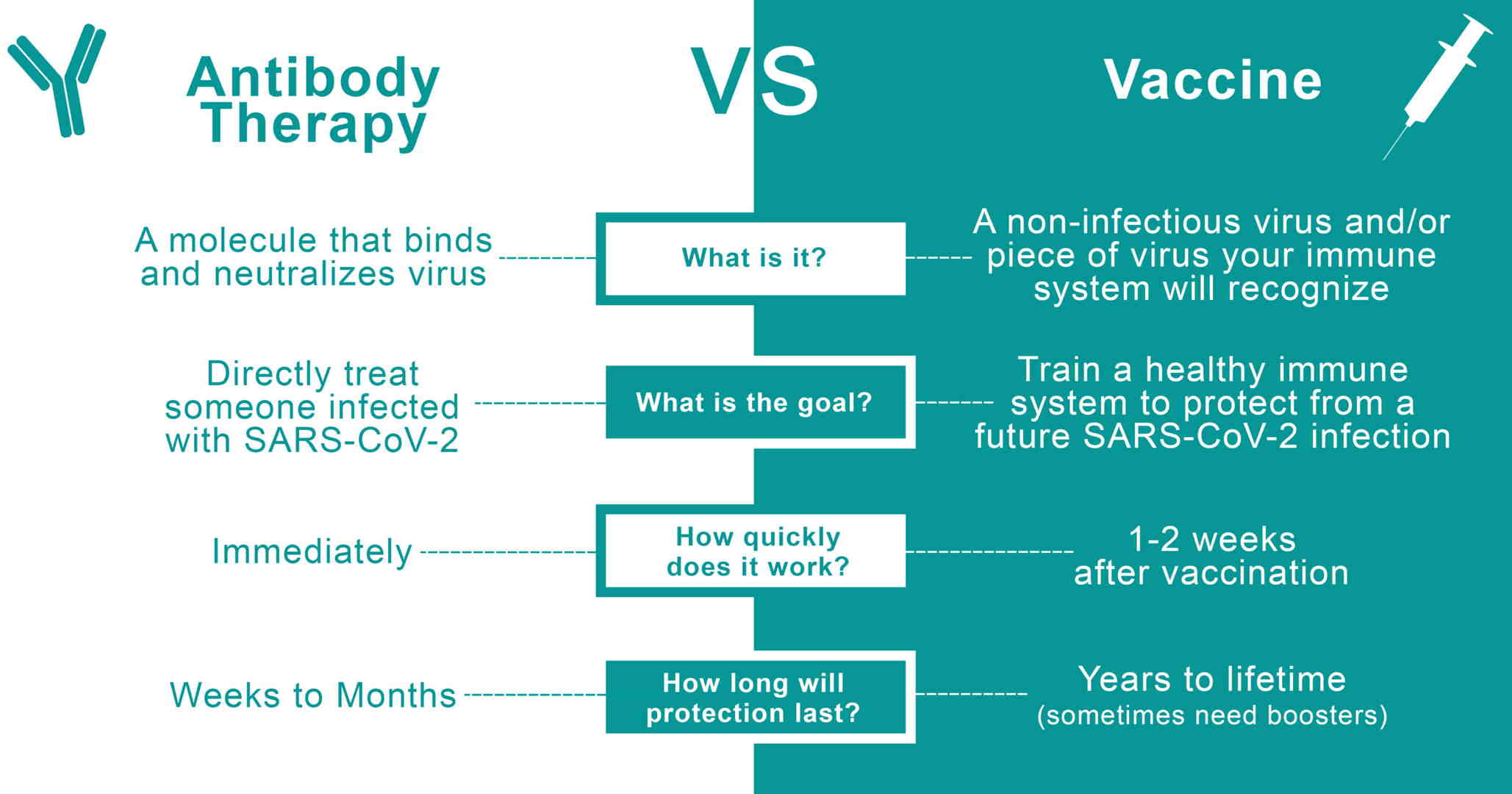
  3. We will develop safe and effective drugs, or other treatments such as passive antibodies that will quickly treat infected persons and halt the transmission.
  4. We revert to severe shelter in place and travel ban protocols long enough to stop the virus from transmitting.

     Epidemics and pandemics end, one way or another. For reference, smallpox -- another airborne viral illness -- killed 400 million people in the 20th century before it was deemed eradicated by the World Health Organization in 1980. The good news is we have seen examples from many other countries where organized projection of tried and true public health strategies of testing, identification of cases, tracing, and quarantine can reduce the transmission of Covid-19 to almost zero. The bad news is that the United States has shown little appetite or capability to do the organized hard work of stamping out the virus. Therefore, we are stuck with waiting for one and/or the other modes of viral decline for the forest fire to end…

Article by Rich Parker - Chief Medical Officer at Arcadia.io. 


Enjoy this blog? Please spread the word :)