

Health Tips


Open Enrollment
Open enrollment season is right around the corner and you may be making some important decisions for you, your family, or even your business. Here are some tips to think about when purchasing health insurance.
Whether you purchase your insurance through the state, government, employer or directly from vendors, this can be a daunting process. There are often many choices, with slight differences that are difficult to decipher. Beyond that, because price transparency is such an issue in healthcare, it is often hard to plan or budget for future costs when there is no way to find out how much these services actually cost! Below, I’ve tried to outline a couple tips while going through this process.
Nothing is free!!: Many patients get a large portion of their health insurance paid for by a third party (employer, government, etc). This creates the notion that health care is cheap or free in certain situations. Please remember that although you may not pay much in monthly premiums or out of pocket costs for your insurance, your employer is likely paying an exorbitant amount for health care services you may not even use. This cost has gone up considerably in the last few years
Know your family: Unfortunately, because this can be so complicated, many patients simply select the most inclusive insurance options, which are also the most expensive. Sit down and review what medical services you and your family have used over the past few years. What medications do you require monthly, if any? Do you see specialists, and why? Do you know of any bigger health expenses that may come up next year (like planning for a child or an elective surgery)? Or do you just really need a good primary care physician who has time to address all of your medical needs? (Hint: the answer for almost everyone is yes!)
Understand premiums and deductibles: Just to review, a premium is the amount that you (or a third party) pay monthly for the privilege of being insured. The deductible is the total amount of out of pocket costs you and your family can incur during the year on top of the monthly premium you already pay. The lower your monthly premiums, the higher your out of pocket costs may be… though you still might save money this way! For instance, for a young family of 4 buying insurance from BCBS, the monthly premium for a $2,800 deductible plan is about $500 more a month than the $12,000 deductible plan… that’s $6,000 extra in monthly premiums over the course of the year!!! Why would anyone pay that much extra when good primary care can cover 85-90% of issues that will ever come up? Even the $2,800 deductible plan listed above leaves a family paying out of pocket for much of their costs in a year. Those costs are often inflated because of insurance and the amount is completely unknown to the patient prior to utilizing the service (try to think of another purchase you make where you do not know the cost prior to buying?!?).
Understand premiums and deductibles: Just to review, a premium is the amount that you (or a third party) pay monthly for the privilege of being insured. The deductible is the total amount of out of pocket costs you and your family can incur during the year on top of the monthly premium you already pay. The lower your monthly premiums, the higher your out of pocket costs may be… though you still might save money this way! For instance, for a young family of 4 buying insurance from BCBS, the monthly premium for a $2,800 deductible plan is about $500 more a month than the $12,000 deductible plan… that’s $6,000 extra in monthly premiums over the course of the year!!! Why would anyone pay that much extra when good primary care can cover 85-90% of issues that will ever come up? Even the $2,800 deductible plan listed above leaves a family paying out of pocket for much of their costs in a year. Those costs are often inflated because of insurance and the amount is completely unknown to the patient prior to utilizing the service (try to think of another purchase you make where you do not know the cost prior to buying?!?).
.
Consider Medical Cost Sharing or Healthshare: Healthcare Sharing, or Groups, are non-profit organizations of like-minded individuals that pool their money together every month to help each other with serious medical costs. They are NOT considered insurance. They work great with Direct Primary Care.The majority are Christian based ministries except for Sedera Health (sedera.com). The Christian based Ministry groups usually require members to adhere to moral and ethical principles that result in lower healthcare costs; such as not smoking, avoiding excessive alcohol, no extra marital sex, and no illicit drugs. Since these plans are not insurance, they can restrict or refuse Approval, i.e. exclude for pre-existing conditions. Sedera Health is different. It does not require you to adhere to moral or ethical principals and is not a Christian based. These health sharing plans can provide catastrophic healthcare protection (like health insurance should be doing) for significantly lower monthly costs.
.
So, if you have a relatively healthy family, ask yourself why you (or your employer) pay so much more in premiums for, what should be, cheap and comprehensive primary care services. And wouldn’t you want an affordable, budgetable, transparent monthly fee that will cover most everything that will come up during a given year including keeping you out of an expensive urgent care and or even worse, the emergency room.
- If you do have some chronic medical concerns, think about the specialists you are seeing and the different medications you're on. Is YOUR Primary Care Doctor putting all the pieces together?
- Is you current doctors taking your finances into consideration when prescribing and ordering expensive medications/tests without thinking about it?
- Is you current doctor part of a hospital system and only recommending specialists "in the system"?
- Does your doctor expedite changes in your treatment plan and save you trips to the office?
.
If the answer is a No to the questions above or you're just unsure, it’s probably worth making a 15-20 minute, Meet & Greet appointment here at Balanced Physician Care so we can discuss how our practice will work with your medical and insurance needs. The best part is, the consultation is free! (Schedule your visit here or give us a call at 904-930-4774

115 Professional Drive Suite 104
Ponte Vedra Beach, FL 32082
904-930-4774
www.BalancedPhysicianCare.com
Dr Truty’s Top 10
Inflammation is not always a bad thing – it is necessary when you have an infection or injury, as it helps with healing, directing nourishment and immune activity to the affected site. It is when inflammation is ongoing or chronic, or serves no real purpose, that inflammation can be harmful – damaging the body and leading to illness.
Here are the top 10 anti-inflammatory foods to add to your shopping list

Upfront Surgery Pricing
As Americans grapple with a health care system that costs $10,000 per person annually, a form of health care that avoids the insurance system — known as direct primary care — is starting to become an alternative option.
The American Academy of Family Physicians defines direct primary care as giving “family physicians a meaningful alternative to fee-for-service insurance billing, typically by charging patients a monthly, quarterly, or annual fee. This fee covers all or most primary care services including clinical and laboratory services, consultative services, care coordination, and comprehensive care management.”
The model aims to simplify the system for both health care professionals and patients.
“We have significant bottlenecks and barriers in health care both on the provider side as well as the patient side,” Dr. Akash Goel, a gastroenterologist at Weill Cornell/New York-Presbyterian Hospital, told Yahoo Finance.
“So from a provider perspective,” Goel explained, “people are rightly frustrated because they're overburdened with [a high number of patients], short patient visits, unsatisfactory timelines to interact with patients, pressure from billing and external pressures that I think are on physicians that make the experience somewhat unsatisfactory.”

From a patient perspective, “people have insurance, but they're paying a lot for it,” Goel said. “The average person is spending somewhere in the range of $10,000 a year on health care, and they have high-deductible plans, so you have health insurance, but you don't necessarily get to use it because of the high deductibles or you have to pay out-of-pocket for it.”
The direct primary care model is “a little bit more streamlined in terms of receiving your health care,” according to Goel, partly because it limits the number of patients doctors are seeing and gives patients the option to avoid costly insurance plans.
‘We believe the system is broken’
Surgeries handled through the direct primary care method involve patients being able to see the total price for an operation and find a specialist for that price.
At the Surgery Center of Oklahoma, patients do exactly that. They choose surgeries at specific prices and pay a flat rate up front, with no insurance involved. The center was started by anesthesiologists Keith Smith and Steven Lantier. After years practicing medicine, they felt growing “frustration” with the health care system.
“We both started despising what was going on financially with the patients,” Lantier told Yahoo Finance (video above). “Because when you look at the bankruptcy statistics — medical bankruptcies for patients now — it’s egregious. The average American cannot afford health care today, so we believe the system is broken.”

‘The reason we could put it online is because we don’t take federal money’
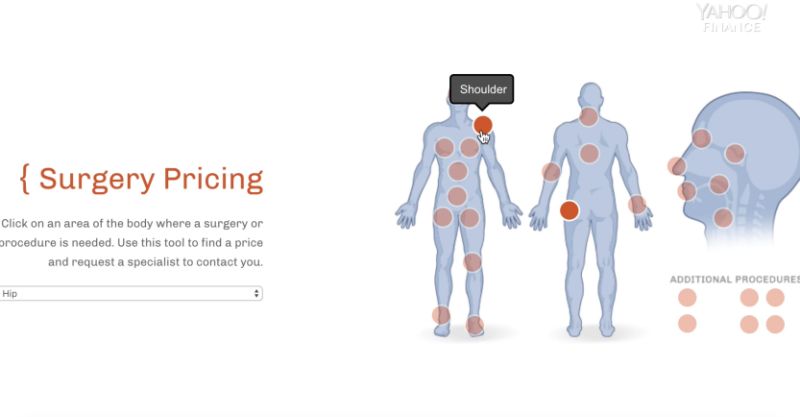
The Surgery Center of Oklahoma’s website allows potential patients to look up price quotes for all kinds of surgeries. Individuals simply have to click on the area of the body where they would need a surgery or a procedure done, find the exact name of the procedure, and a price is generated. From there, an option appears to request a specialist for further details.
“We took all of the numbers, added them up, then added about a 10 or 15% margin to all of that, and that’s the price we put it online,” Lantier explained. “The reason we could put it online is because we don’t take federal money. If we took any federal money — Medicare or Medicaid — we couldn’t do that.”
-Article by written by Adriana Belmonte, Yahoo Finance, 5/18/2019